
Our Research
Over four years, the project will build local skills and expertise, generate reliable data, develop monitoring and surveillance tools, construct and improve wetlands, and strengthen collaboration between environmental, human, and animal health sectors. By the end of the project, it aims to reduce AMR levels, improve access to clean and safe water, lower the burden of infectious diseases, and support sustainable economic development.
The project will answer 6 research questions
- How do abiotic and biotic factors influence the levels and concentrations of antibiotics and antimicrobial resistance genes in aquatic environments?
- How is environmental AMR linked to human and animal health?
- How can eco-hydro wetlands be optimised to remove antibiotics, antimicrobial resistance genes and multidrug-resistant pathogens from wastewater?
- What is the economic cost of AMR?
- How can Community Engagement and Involvement be enhanced to reduce AMR spread?
- What capacity can be built for sustainable research and management of environmental AMR?
The 6 research questions will be answered through our 6 Work Packages
Work Package 1
Detection, Assessment and Quantification of Pathogens and ARGs in Aquatic Environments and Their Links to Human and Animal Health
Work Package 2
Development and Optimisation of Innovative Eco-hydro Wetland
Work Package 3
Development of a Digital AMR Online Hub for Improved Public Health
Work Package 4
Economic Evaluation
Work Package 5
Avenues of Community Engagement and Involvement
Work Package 6
Capacity Building for Sustainability
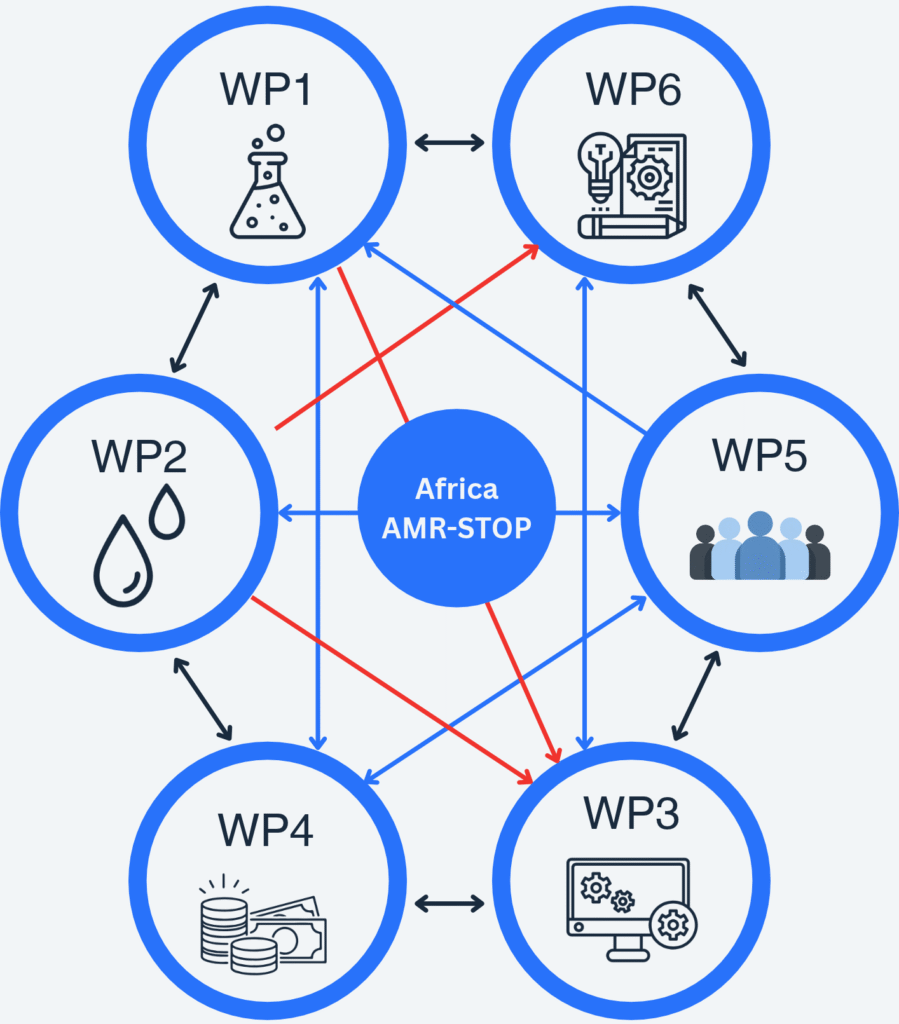
Our research is structured around the 6 strongly interrelated work packages, depicted in the diagram on the right:
- WP1 directly interacts with WP2, WP4 and WP6
- WP2 directly interacts with WP1, WP4 and WP5
- WP3 integrates all outcomes from other work packages
- WP4 directly interacts with WP1, WP2 and WP5
- WP5 complements community engagement activities in other work packages
- WP6 utilises the other work packages for capacity building and strengthening
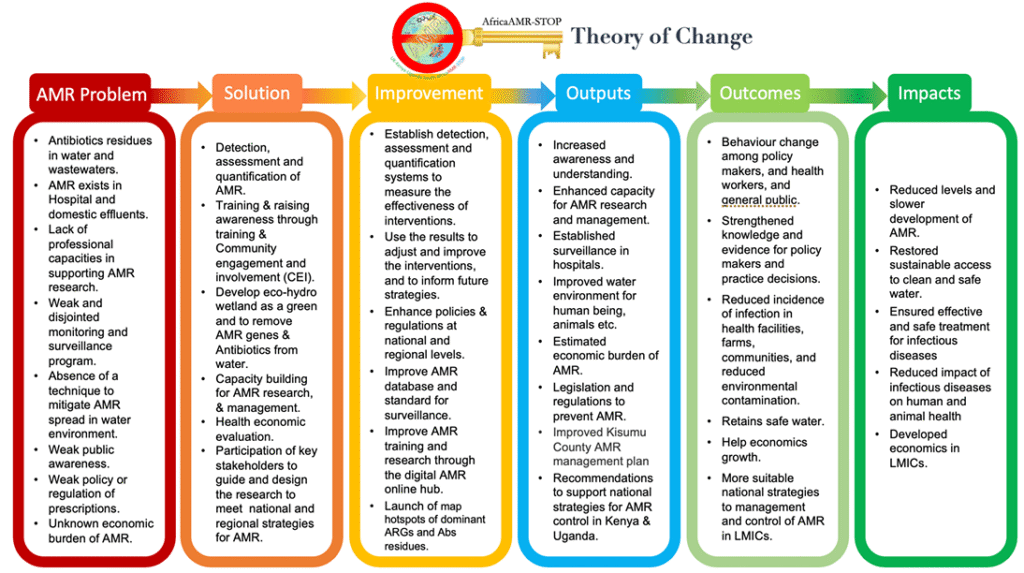
Africa AMR-STOP Theory of Change
Our Theory of Change outlines how we will work closely with stakeholders, local governments and communities to deliver high-quality applied research to make a step change in management and control of AMR in Kenya and Uganda.